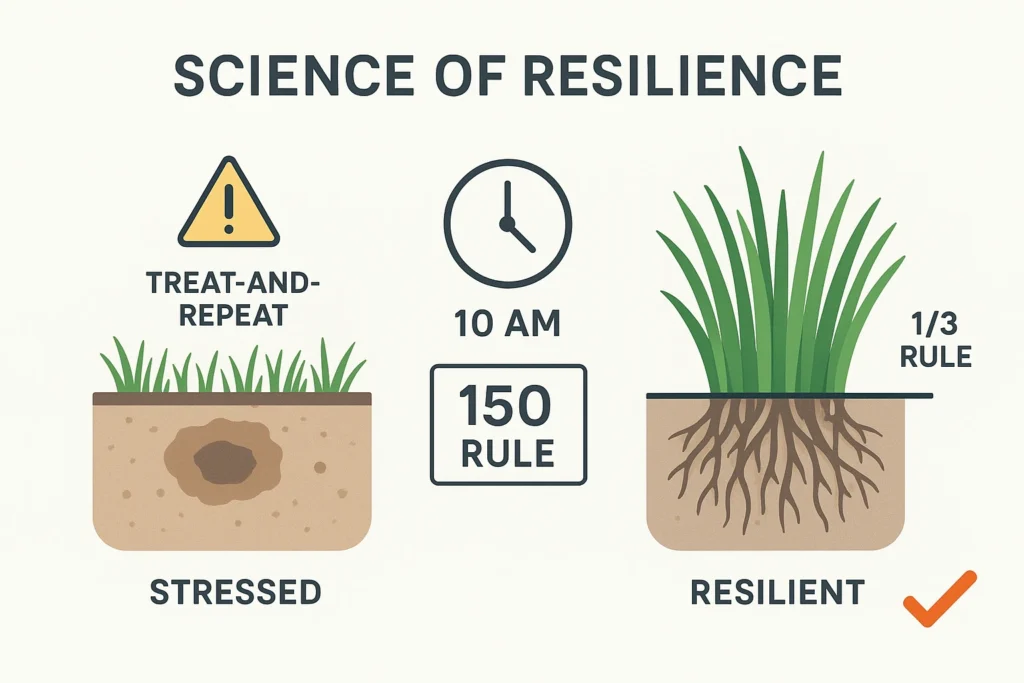
You’ve likely been there: You spot a brown patch, you apply a fungicide, the grass recovers, and two weeks later, the fungus returns. This cycle is exhausting and expensive.
The hard truth is that fungicides are temporary resets, not permanent cures. While chemical controls handle the immediate outbreak, your lawn’s long-term health is determined by “cultural practices”—the daily and weekly routines regarding water, mowing, and soil management.
Most homeowners treat these routines as a simple checklist. However, from a pathological perspective, every time you mow or water, you are either building immunity or creating an incubator for disease. The difference between a resilient lawn and a sick one isn’t usually luck; it’s the science of leaf wetness, root stress, and environmental timing.
This guide moves beyond generic “spring cleanup” tips to explain the pathology behind lawn care, helping you decide if you have the bandwidth to manage these strict protocols or if it’s time to partner with a specialist.
The Mistake-to-Malady Framework
Disease doesn’t happen in a vacuum. It requires three things: a host (your grass), a pathogen (fungi spores), and a conducive environment. You can’t eliminate the spores—they are always in the air and soil. Your only control lever is the environment.
Many common lawn “failures” are actually predictable outcomes of specific cultural mistakes. Understanding this cause-and-effect relationship allows you to stop fighting symptoms and start removing the cause.
From Mistake to Outbreak
- The Mistake: Frequent, shallow watering.
- The Pathology: Roots stay near the surface to chase water. When heat hits, the plant enters drought stress immediately, becoming susceptible to Summer Patch.
- The Mistake: Scalping the lawn (mowing too low).
- The Pathology: This reduces the leaf surface area available for photosynthesis. The grass must shed root mass to survive, weakening its defense against Necrotic Ring Spot and increasing weed pressure by up to 80%.
- The Mistake: Ignoring soil compaction.
- The Pathology: Compaction creates anaerobic conditions (lack of oxygen). This suffocates beneficial microbes and favors pathogens like Pythium Blight, especially in drainage-poor areas.
The 10 AM Protocol: Optimizing Irrigation
If you ask ten neighbors when they water, you’ll get ten different answers. However, when we look at the research from the USDA National Institute of Food and Agriculture (NIFA), there is a definitive right answer for disease prevention.
The critical metric here is Leaf Wetness Duration. Fungal spores need moisture on the leaf blade to germinate and penetrate the plant tissue.
- Deep Watering at 10 PM (High Risk): The lawn stays wet all night. This extended period of moisture is the primary driver of Dollar Spot and Brown Patch.
- Watering at 10 AM (Low Risk): This is the sweet spot. The sun is high enough to dry the leaf blades relatively quickly after the cycle finishes, but it’s not yet hot enough to cause massive evaporation loss.
Implementing an efficient sprinkler system isn’t just about coverage; it’s about timing control. If your current schedule is set to “set it and forget it” at the wrong time of day, you are actively fighting against your fungicide treatments.
The Science of Resilience: Mowing and Soil Density
Beyond water, the physical structure of your turf and soil determines its immunity.
The 1/3 Rule and Stress Management
The “1/3 Rule” states you should never remove more than one-third of the grass blade in a single mowing. Why? Because cutting more shocks the plant. To recover, the grass halts root growth to redirect energy to the shoots.
If you consistently violate the 1/3 Rule—common when trying to stick to a weekly schedule despite rapid spring growth—you effectively starve the root system. A shallow root system cannot uptake the nutrients required to fight off infection.
Soil Compaction and Airflow
Disease thrives in stagnant air and compacted soil. When soil particles are pressed too tightly together, water sits on the surface rather than infiltrating, creating a breeding ground for rot. This is why lawn aeration in Atlanta and other clay-heavy regions is not optional; it is a pathological necessity. By mechanically removing cores of soil, you reintroduce oxygen to the root zone, stimulating the microbial activity that naturally suppresses pathogens.
Calculating Risk: The 150 Rule
How do you know when your cultural practices aren’t enough and chemical intervention is necessary? Professional turf managers use the “150 Rule.”
This rule helps predict the onset of heat-related diseases like Pythium and Brown Patch. The formula is simple:
Daytime Temperature + Relative Humidity = Stress Score
If that score exceeds 150, your lawn is in the “Danger Zone.” For example, if it is 85°F with 70% humidity (Total: 155), fungal spores are germinating rapidly.
When the 150 Rule is triggered, cultural practices alone (like proper mowing) may not hold back an outbreak. This is when preventative applications become critical. Knowing this threshold helps you understand why Atlanta lawn problems often spike suddenly in mid-summer, even if you’ve been mowing correctly.
Regional Nuances: One Size Does Not Fit All
A major failure in generic lawn care advice is treating all climates the same. The cultural practices that save a lawn in Ohio might destroy one in Georgia. Understanding turf zones is vital for tailoring your approach.
The Southeast Transition Zone (Bermuda/Zoysia)
In the transition zone, the risk often comes during the “green-up” phase. Applying high-nitrogen fertilizer in Alpharetta, GA too early in the spring can trigger Large Patch disease. The grass is waking up, but the soil is still cool/damp—forcing growth with fertilizer feeds the fungus, not the plant.
The Northern Cool Season (Fescue/Bluegrass)
For our northern neighbors, the battle is often against Snow Mold in the spring and heat stress in the summer. Leaving grass too long before winter mats it down, trapping moisture under snow cover. Conversely, in summer, cool-season grasses naturally want to go dormant. Fighting this dormancy with excessive water often leads to brown patch grass issues rather than a green lawn.
Decision Time: DIY vs. Professional Management
Understanding the science is the first step; executing it consistently is the second. Most homeowners can handle mowing and basic watering. However, the complexity increases when you try to synchronize fertilization, aeration, and preventative treatments with the 150 Rule.
If you are evaluating whether to handle this yourself or bring in a partner, consider the “Consistency vs. Complexity” matrix below.
The DIY Path
- Best for: Enthusiasts who enjoy the science, have flexible schedules to water/mow at optimal times, and own calibration equipment for spreaders.
- Risk: Missing a preventative window by 3 days during a high-humidity week can result in significant turf loss.
The Professional Partner Path
- Best for: Homeowners who want the results of the 150 Rule without tracking daily humidity levels.
- Value: We monitor regional pathogen pressures and adjust nutrient inputs accordingly. For example, we might switch to a slow-release annual lawn maintenance plan during high-stress periods to avoid forcing growth that the roots can’t support.
Next Steps for a Resilient Lawn
Cultural practices are the foundation of a healthy lawn, but they require precision and consistency. If you are tired of the “treat-and-repeat” cycle and want a lawn that is built to resist disease naturally, it might be time to bring in the experts.
We don’t just apply product; we manage the ecosystem of your soil. Contact us today for a comprehensive lawn assessment, and let’s build a maintenance plan based on science, not just the calendar.
Frequently Asked Questions
Q: Can I just water more to help the grass recover from disease?
A: Usually, no. If the disease is fungal (like Brown Patch or Pythium), adding water often adds fuel to the fire. You need to identify the disease first.
Q: Does bagging grass clippings prevent disease spread?
A: If disease is currently active, yes—bagging removes the spores. However, on a healthy lawn, mulching clippings returns nitrogen to the soil and improves resilience.
Q: Why did my neighbor’s lawn survive the heat wave while mine developed fungus?
A: It likely comes down to root depth and soil structure. If they have been aerating and mowing high for years, their lawn has a stronger immune system, allowing it to withstand the “150 Rule” stress triggers better than a lawn with shallow roots.