Managing expansive commercial landscapes and massive HOA properties used to be a simple equation: scale your labor force alongside your acreage. Today, that equation is broken.
With landscaping industry employment projected to grow a mere 3% through 2032, operators and property managers are feeling the intense squeeze of labor scarcity, H-2B visa constraints, and relentless wage inflation. You can no longer just throw more crews at a sprawling commercial contract and expect to maintain healthy margins. The most successful operators are fundamentally changing their approach, shifting away from a collection of isolated tools toward an integrated operational framework.
This isn’t just about buying bigger mowers or downloading a new routing app. It is about creating a symbiosis between specialized commercial hardware and digital telematics. Let’s explore the logistics, equipment strategies, and reporting metrics required to transform your commercial turf operations from labor-heavy to tech-efficient.
The New Commercial Math: Moving from Hands to Systems
Evaluating your approach to turf management for commercial properties requires looking at your operation holistically. When your highest cost is human capital, every minute a crew spends sitting in traffic, searching for equipment, or over-watering a property eats directly into your profitability.
Survival in the large-scale turf sector means treating efficiency as your primary product. You are no longer just delivering cut grass and green turf; you are delivering operational certainty. This is achieved by combining eco-friendly agronomy with precise logistical planning.
Optimizing Service Routes for Multi-Property Commercial Accounts
The gap between a profitable commercial contract and a losing one often comes down to route density. Traditional routing software focuses solely on getting a truck from Point A to Point B. But true commercial logistics require a deeper understanding of fleet capabilities.
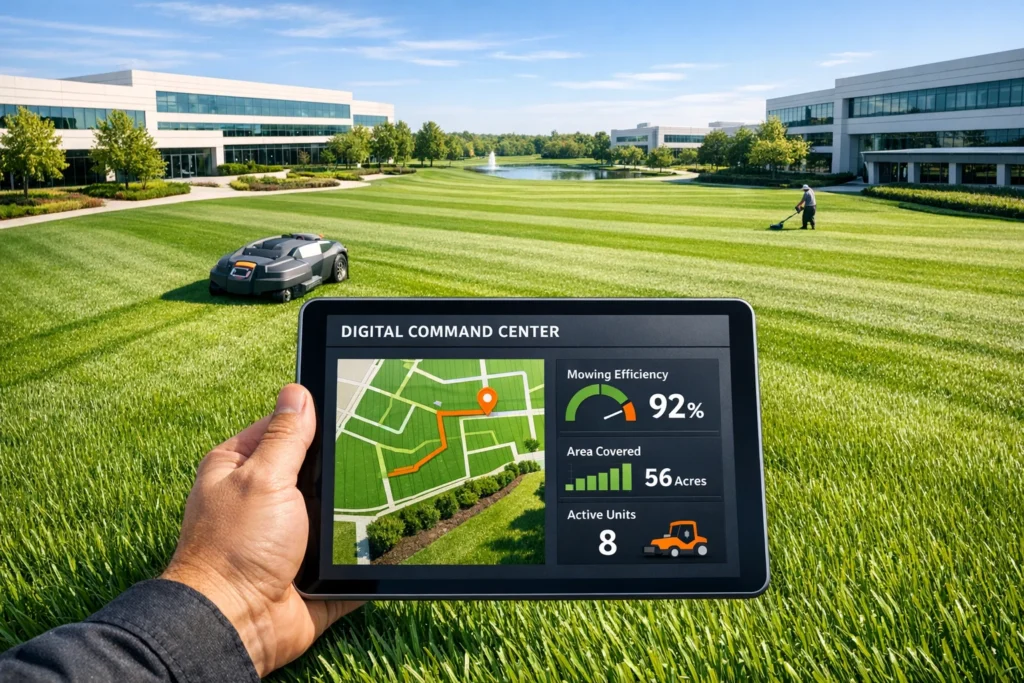
When you integrate telematics with GPS routing, you establish a Digital Command Center. This allows you to plan routes based on real equipment capacity rather than just map distance. If a specific crew is hauling wide-area mowers designed for expansive industrial parks, routing them through congested residential areas to hit a smaller commercial lot destroys your margin.
Smart routing systems also enable “Shadow Board” logistics—a method where digital checklists ensure every specialized tool is loaded before a rig leaves the yard. This prevents the costly mid-day return trips that quietly drain labor hours.
Specialized Equipment for Large Acreage Turf Management
You cannot scale commercial operations using residential-grade setups. High-volume operators rely on the “Three-Rig” physical strategy, optimizing trailer loads specifically for multi-acre speed.
The biggest shift happening right now is the deployment of commercial autonomous mowers. Modern robotic units can comfortably handle up to 15 acres per unit, operating 24/7 without fatigue. By deploying autonomous units to manage the wide-open acreage, you free up your highly skilled, scarce human labor for complex detail work, trimming, and localized weed control service applications.
Equipment Replacement and Fleet Protection
Running a high-value commercial fleet requires strict adherence to lifecycle management. Experienced operators use the “1,500-hour rule” for commercial mowers. Pushing equipment past this threshold almost guarantees surprise downtime and expensive reactive maintenance.
Furthermore, managing upwards of $500k in mobile assets brings significant risk. Integrating theft-recovery telematics directly into your heavy equipment provides critical risk mitigation, ensuring your high-capacity assets are protected and your service delivery remains uninterrupted.
Managing Water Resources for Commercial Landscapes
Water management is one of the most pressing challenges—and largest line items—for HOA and commercial property managers. Relying on outdated watering schedules not only damages turf health but wastes massive amounts of contract budget.
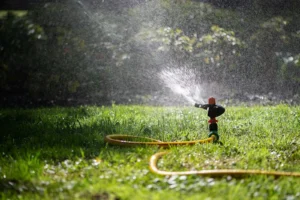
Transitioning to environmental-first agronomy means adopting smart irrigation. When facility managers evaluate the smart irrigation controller vs traditional timer pros cons, the data makes the decision clear. Smart controllers utilize local weather data and soil moisture sensors to reduce water consumption by an impressive 30-50%.
For ornamental beds and specialized planting areas across corporate campuses, understanding drip irrigation pros is equally vital. Drip systems deliver water precisely to the root zone, eliminating evaporation waste and protecting the structural integrity of your landscape assets. Combining drought-resistant turf varieties with precision water delivery creates a sustainable, highly resilient commercial property.
Performance Metrics & Reporting for Commercial Turf Contracts
Property managers and HOA boards share a common hidden anxiety: How do I prove to my stakeholders that our landscaping budget is being used effectively?
If your operational improvements stop at efficiency and fail to translate into client reporting, you are leaving client retention up to chance. High-value accounts require absolute transparency. They need more than a green lawn; they need a KPI dashboard.
Top-tier turf management for corporate properties involves generating automated, post-service reports. Providing your clients with hard data on Labor Utilization Rates, water budget savings, and GPS-stamped “proof of service” transforms your relationship from a replaceable vendor to an indispensable partner. It justifies premium pricing because you are actively reducing the property manager’s liability and oversight burden.
Next Steps for Scaling Your Commercial Operations
Transitioning to a highly efficient, system-driven commercial turf operation requires expert planning. You don’t have to navigate route density optimization, smart water budgeting, and fleet transition alone.
Evaluating your current logistics is the first step toward safeguarding your margins against rising labor costs. Reach out to our team of commercial turf specialists to request a custom operational assessment. We will help you identify the precise intersections where advanced agronomy and modern logistics can elevate your property’s performance and bottom line.
Frequently Asked Questions (FAQ)
How does autonomous equipment integrate with existing manual crews?
Autonomous mowers aren’t designed to replace your crews; they act as force multipliers. While a robotic unit handles the wide, repetitive acreage (up to 15 acres per deployment), your skilled technicians can simultaneously tackle complex edging, pruning, and targeted turf treatments on the same property. This drastically reduces total time-on-site.
What is the ROI timeline for upgrading to smart irrigation controllers on commercial properties?
Because smart irrigation systems reduce water usage by 30-50%, large commercial properties and HOAs typically see a complete return on investment within the first 12 to 18 months, purely from lowered municipal water bills.
Why is the 1,500-hour rule critical for fleet management?
Commercial mowers begin to experience a sharp increase in hydraulic and engine failures after 1,500 hours of operation. Replacing or cycling out equipment before this threshold prevents unexpected breakdowns, eliminates costly emergency repairs, and ensures your crews aren’t left stranded on a commercial site.
How do telematics improve client transparency?
Telematics track exact arrival times, duration on site, and equipment utilization. This allows you to generate automated “proof of service” reports for property managers, providing undeniable data that contract obligations are being met without them having to physically monitor the property.