If you manage a commercial property or sit on an HOA board, you already know the conversation around landscaping has shifted. You aren’t just looking for someone to mow the grass and trim the hedges anymore. You are actively trying to manage liability, justify budget increases, and prevent the kind of negligence lawsuits that keep property managers up at night.
Commercial lawn care has transformed from a basic commodity service into a complex risk management partnership. Recent market data shows that landscaping insurance is now a $645 million market growing at a 5.4% compound annual growth rate. Even more alarming for property owners? There is a massive 62% spike in liability claims during peak landscaping seasons.
When a resident slips on wet grass clippings left on a walkway, or a pet gets sick from an undocumented chemical application, the finger points directly at the property management. Let’s break down how to transition your property from a reactive, high-risk environment into a fully compliant, future-proofed asset.
The HOA Board’s Liability Audit: Identifying Hidden Negligence Traps
The most expensive mistake an HOA or commercial facility can make is treating lawn care as purely aesthetic. Deferred maintenance and surface-level aesthetic fixes often mask underlying safety hazards. In fact, delaying necessary ground maintenance or cutting essential services to save a few dollars typically leads to a 20-40% increase in costs when you are eventually forced to restore the property later.
To effectively manage turf management for commercial properties, boards must conduct a liability audit focusing on negligence traps:
- Slip and Fall Hazards: Are irrigation runoffs causing slick spots on concrete? Are soil plugs from lawn aeration atlanta services being left on high-traffic pedestrian walkways?
- Line-of-Sight Obstructions: Overgrown shrubs near intersections or obscuring crosswalk signage are major liability triggers for vehicular accidents.
- Surface Friction Deterioration: Moss or algae buildup on hardscapes caused by improper grading and drainage requires immediate remediation to prevent resident injury.
Navigating the OSHA General Duty Clause: Why Their Safety is Your Liability
Many property managers mistakenly believe that once a landscaping contract is signed, the liability for on-site safety falls entirely on the vendor. This is a dangerous misconception. Under the OSHA General Duty Clause (Section 5(a)(1)), property owners can be held liable if a contractor fails to maintain a safe, public-facing work zone.
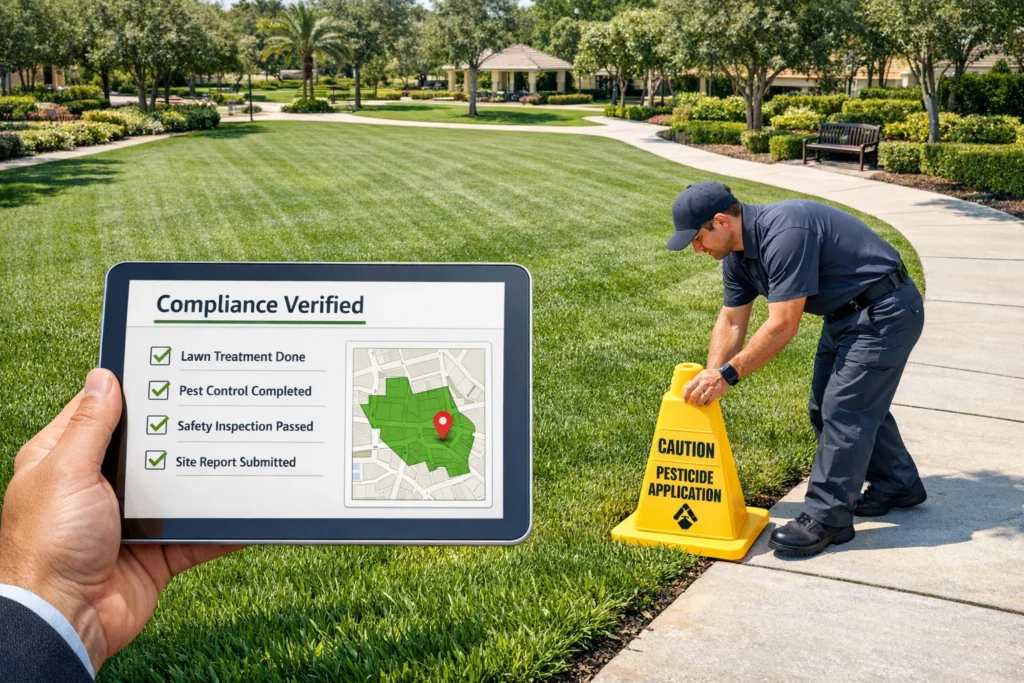
If your landscape provider is actively spraying or operating heavy machinery without using proper safety cones, barriers, and clear signage, your HOA is exposed to regulatory fines and lawsuits.
When vetting vendors, you have to demand more than a generic assurance of safety. Partnering with a dedicated weed pro means demanding a digital paper trail. You need to verify that your service provider is implementing hard boundaries between their equipment and your residents.
Integrated Pest Management (IPM) & Chemical Liability Reduction
The days of blanketing an entire commercial property with heavy chemicals are over. Not only is it financially wasteful, but it dramatically increases your environmental liability. Residents are more educated than ever, frequently asking property managers questions like is pre emergent toxic when they see crews working near playgrounds or water features.
The solution is implementing Integrated Pest Management (IPM). IPM is a data-driven, threshold-based policy that relies on targeted treatments rather than scheduled blanket spraying.
By shifting to an IPM model, you reduce chemical runoff and stay ahead of strict local herbicide regulation. When an issue does arise—such as a brown patch outbreak—you can deploy highly targeted fungicide treatment services only to the affected areas. It’s about proving to your board that you are lowering the community’s chemical footprint while maintaining a pristine landscape.
The 2024-2025 Equipment Roadmap: ROI and Future-Proofing
“Eco-friendly” is no longer just a marketing buzzword; it is becoming a strict regulatory requirement. Environmental mandates, like those set by CARB (California Air Resources Board) pushing for zero-emissions, are setting a national precedent. Gas-powered mowers alone are identified as contributing a staggering 30 million tons of CO2 annually.
For large HOAs and corporate campuses, the transition to sustainable equipment and precise resource management is essential. Just as water conservation efforts have made property managers weigh drip irrigation pros and cons to slash utility budgets, the shift to electric landscape equipment offers massive operational ROI.
Furthermore, electric equipment achieves “Noise Neutrality.” With more residents working from home, noise complaints regarding early-morning gas blowers and mowers are a constant friction point. Transitioning to battery-powered fleets stabilizes operations, increases resident satisfaction, and proves that your approach to turf management for corporate properties is ahead of the curve.
Education is Risk Mitigation
To effectively future-proof, your provider must understand the science behind the green. Knowing exactly what is the difference between a starter fertilizer and a maintenance fertilizer? isn’t just agronomy—it’s compliance. Applying the wrong product at the wrong time leads to nutrient runoff, which can violate local watershed protections and result in heavy fines for the HOA.
Solving the “Lazy Tech” Problem: The Digital Accountability Protocol
If you read reviews for legacy “big box” landscaping companies, a common theme emerges: the skepticism of the “lazy technician.” Residents complain that crews skipped sections, rushed through applications, or didn’t show up at all.
You cannot manage liability based on the honor system. Modern compliance requires a digital accountability protocol. High-level service providers are now utilizing transparency technology—such as GPS tracking, service timestamps, and photo documentation.
If a resident complains about inconsistent weed control atlanta ga boards shouldn’t have to guess if the job was done. They should be able to instantly pull up a digital audit trail proving exactly what was applied, where it was applied, and at what time. This “Evidence Portfolio” completely neutralizes resident skepticism and protects the board from accusations of financial mismanagement.
Next Steps for Securing Your Property
Evaluating a commercial lawn care provider shouldn’t feel like a leap of faith. Your property requires an environmentally conscious, tech-enabled partner that puts compliance and risk mitigation first.
Don’t wait for a liability claim to force a change in your grounds management strategy. Review your current contract, audit your community’s high-risk zones, and demand a vendor that provides the digital accountability your HOA board deserves.
Frequently Asked Questions (FAQ)
How does an eco-friendly transition actually save the HOA money?
While the upfront transition to eco-friendly practices (like battery-operated equipment and smart irrigation) might require a slight initial adjustment, it protects the HOA against skyrocketing regulatory fines, lowers long-term chemical application costs through IPM, and reduces noise complaint administrative hours. Furthermore, preventing a single slip-and-fall lawsuit easily offsets years of preventative maintenance costs.
How do we prove to our insurance provider that we are mitigating risk?
Insurance providers look for documented protocols. By partnering with a landscaping service that provides a “Digital Paper Trail” (GPS logs, photo evidence of safety barriers, and written IPM threshold data), you hand your insurance adjuster concrete proof of proactive risk management.
Does Integrated Pest Management (IPM) mean our property will look worse?
No. IPM doesn’t mean ignoring weeds or pests; it means treating them intelligently. Instead of blanketing the property in chemicals, professionals monitor the turf and treat issues precisely when they reach a specific threshold. This keeps the grass pristine while dramatically lowering chemical exposure to residents and pets.