For decades, homeowners have been forced to choose between two polarizing options: a lawn that is safe for their family and pets, or a lawn that is actually free of disease. This “Eco-Friendly vs. Actually Works” trade-off is the primary friction point for 64% of homeowners considering organic care. You want to reduce your environmental footprint, but you aren’t willing to accept a yard ridden with Necrotic Ring Spot or Dollar Spot just to prove a point.
We understand that hesitation. The industry has historically marketed organic care as “chemical-free”—a negative definition that tells you what you aren’t getting, but fails to explain how the lawn will survive.
At Weed Pro, we are shifting the conversation from “chemical-free” to “Soil Microbiome Enhancement.” This isn’t about crossing your fingers and hoping nature takes its course; it is a clinical, data-driven approach to turf health. By leveraging biological intelligence, we bridge the gap between academic theory and the lush, resilient turf you demand.
The Mechanism: Why Biologicals Are Outperforming Chemicals
To understand why modern biological programs work, we have to look at the soil crisis created by traditional management. Years of synthetic fungicide overuse have created a “chemical dependency” loop. While these chemicals kill pathogens, they also sterilize the soil, reducing its inherent suppressiveness.
Research from Cornell University and NC State Extension indicates that a diverse soil microbiome is the primary defense against turf disease. When we apply biological controls, we aren’t just treating a symptom; we are introducing “beneficials”—microscopic defenders that outcompete pathogens for resources.
The Efficacy Data
The skepticism regarding organic speed and potency is outdated. Recent analysis reveals that high-quality biological agents, such as Bacillus subtilis, can achieve up to 78.14% disease suppression in established organic soils. This rivals the efficacy of many synthetic fungicides, but without the environmental toxicity.
It requires a shift in mindset: we are moving from “sterilization” (killing everything) to “competitive exclusion” (crowding out the bad guys).
Building the Shield: Beneficial Microbes in Action
The “Clinical Organic” approach relies on specific mechanisms of action. It is not enough to simply spread organic compost (Roswell and similar markets have seen a surge in generic “compost” products that lack specific microbial loads). True biological management involves targeted applications.
Key Players in the Microbiome
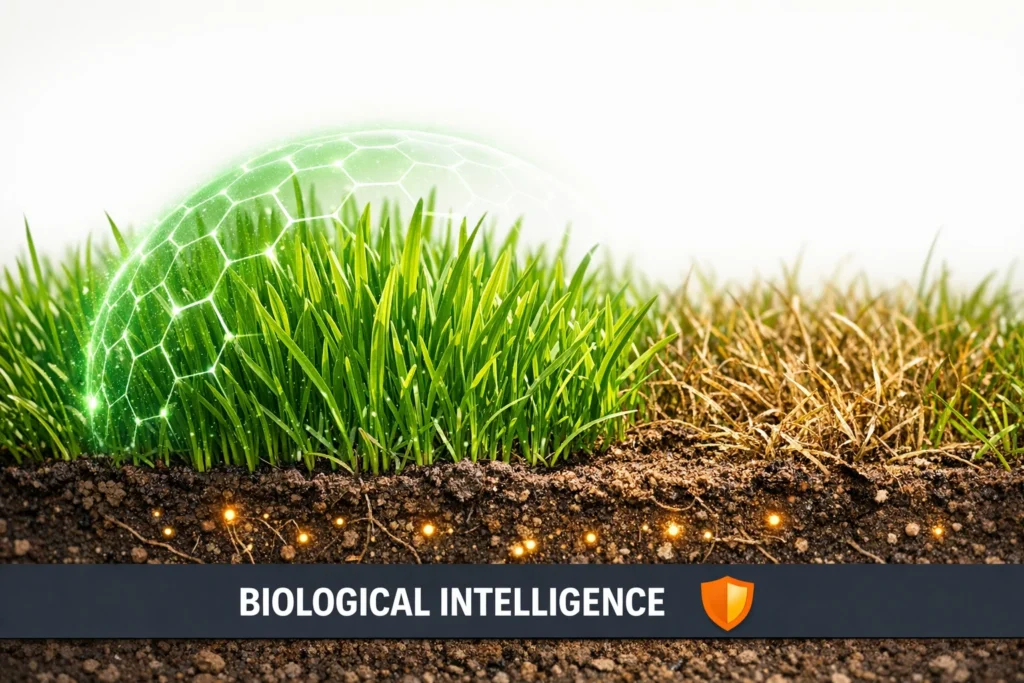
- Bacillus subtilis: This bacterium colonizes the root system, creating a physical biofilm that prevents pathogens from penetrating the root tissue. It essentially creates a force field around your turf’s foundation.
- Trichoderma: A beneficial fungus that aggressively attacks pathogenic fungi. It enzymes break down the cell walls of diseases like Brown Patch.
This biological activity works in tandem with how cultural practices prevent lawn disease cycle recurrence. By combining proper mowing and watering with a high-activity microbiome, you create an environment where disease simply cannot gain a foothold.
The “Transition Year”: Navigating the Detox
One of the most critical aspects of moving to a biological program is managing the “Transition Period.” If your lawn has been subjected to synthetic fertilizers and fungicides for years, the natural biology is likely dormant or dead.
When you switch to a biological program, there is often a lag time while the soil life rebuilds. We call this the “Re-Wilding” phase. During this 12-month window, your lawn is weaning off its chemical dependency. You might see a temporary plateau in color or minor disease pressure as the ecosystem re-balances.
This is normal, and it is temporary. The goal is to break the addiction so that your lawn becomes self-sufficient. To accelerate this, we often employ liquid aeration to fracture compacted soil and allow oxygen to reach the recovering microbes. This is particularly vital in heavy substrates; seeing how liquid aeration clay soil treatments open up porosity can be the turning point for a transitioning lawn.
Regional Challenges and Soil Specifics
Biological disease management is not a one-size-fits-all product; it is a localized prescription. Soil composition dictates success. For example, in areas with heavy clay, pathogens like Necrotic Ring Spot thrive because roots are suffocated.
In these environments, simply applying organic fertilizer isn’t enough. You must address the physical structure of the soil. Utilizing liquid aeration services (Acworth and other service areas often have high demand for this) creates the necessary gas exchange for beneficial microbes to survive. Without oxygen, even the best biological treatments will fail.
Furthermore, identifying local stressors is key. Whether it is Atlanta lawn problems related to humidity or high-altitude fungal pressures in other regions, the biological solution must be matched to the specific pathogen.
Your Decision Matrix
As you evaluate lawn care partners, look for “Biological Intelligence.” Are they talking about N-P-K ratios (old school), or are they talking about soil suppressiveness and microbial activity (modern science)?
If you notice lesions on your grass blades or distinct patches of discoloration, do not reach for a generic fungicide that comes with a “Keep Off Grass” warning. Use a biological identification approach.
Frequently Asked Questions
Is biological disease control safe for pets?
Yes. This is a primary differentiator. Unlike synthetic fungicides which often carry re-entry intervals (REI) requiring you to keep pets off the lawn for 24-48 hours, biological treatments have an REI of effectively zero minutes.
Will it work as fast as chemicals?
In an acute outbreak, synthetic chemicals provide a “knockdown” effect that is faster, but short-lived. Biologicals take longer to establish but provide a “shield” effect that lasts longer. During the transition year, we ask for patience as the soil immunity builds.
Why is it more expensive?
You are paying for higher-quality ingredients and a reduction in long-term inputs. Chemical programs are cheap because they are a temporary fix—a rental. Biological programs are an investment in the permanent health of your soil.
Can I just use DIY products?
While products are available, the diagnosis is the hard part. Many homeowners search for liquid aeration near me or organic fungicides only after they have misdiagnosed the disease, wasting time and money. Professional biological management ensures the right microbe is matched to the right pathogen.
Conclusion
The shift to biological disease management is the future of responsible land care. It allows you to maintain a high-quality turf without compromising the safety of your backyard ecosystem. By respecting the soil microbiome and understanding the science of suppression, Weed Pro delivers results that are both effective and sustainable.
Ready to see if your soil is ready for a biological transition? Contact our team today for a comprehensive soil analysis.