Key Takeaways:
- Topsoil quality naturally declines over time in suburban lawns without intentional maintenance.
- Construction practices and repeated disturbance accelerate topsoil degradation.
- Poor topsoil limits root depth, water movement, and nutrient availability.
- Many lawn problems stem from slow, unseen soil decline rather than surface-care mistakes.
- Improving topsoil quality restores turf resilience, density, and recovery ability.
Why Topsoil Quality Is Easy to Overlook
Topsoil is one of the most important and most neglected components of a healthy lawn. In suburban landscapes, lawns often look fine on the surface while the soil beneath steadily loses structure, organic matter, and biological activity. Because this decline happens gradually, homeowners rarely connect it to thinning turf or recurring lawn issues.
Unlike sudden damage from pests or drought, declining topsoil quality works quietly. Grass may grow, but it grows with limitations. Over time, those limitations show up as weaker roots, poor stress tolerance, and lawns that struggle no matter how carefully they’re watered or fertilized.
What Defines Healthy Topsoil?
Healthy topsoil supports turf by balancing physical structure, biology, and nutrient-holding capacity. It isn’t just “dirt,” it’s a living system that allows roots to breathe, grow, and function efficiently. High-quality topsoil typically has:
- Stable structure with good pore space
- Adequate organic matter
- Active microbial populations
- Balanced moisture retention and drainage
When these elements decline, turf performance follows.
How Suburban Development Starts the Decline
In many suburban neighborhoods, topsoil quality is compromised before a lawn is even planted. During construction, topsoil is often stripped, compacted, mixed with subsoil, or redistributed unevenly. What looks like a finished lawn may already be working with a weakened soil foundation.
Once construction ends, lawns are expected to perform indefinitely, but the original topsoil conditions were never restored. From that point on, every stress compound the problem.
Why Topsoil Quality Declines Over Time
Topsoil degradation is usually the result of cumulative stress rather than a single event. Suburban lawns face repeated pressure that slowly breaks down soil structure and biological activity. Common contributors include:
- Foot traffic and routine use
- Repeated mowing equipment passes
- Heavy rainfall followed by surface sealing
- Lack of organic matter replenishment
- Overreliance on synthetic inputs without soil support
Each factor chips away at topsoil performance, even if turf remains green for years.
The Role of Organic Matter Loss
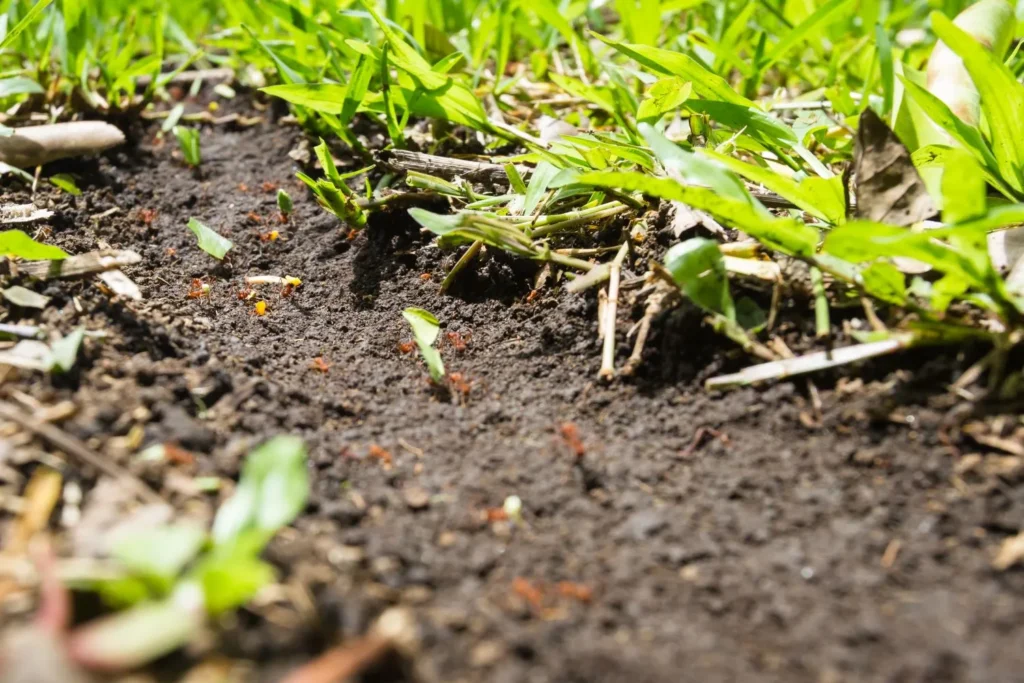
Organic matter is the engine of topsoil health. It fuels microbes, improves structure, and helps soil manage water and nutrients. In suburban lawns, organic matter is constantly removed or broken down faster than it’s replaced.
Bagging clippings, removing leaves, and failing to return organic inputs gradually starve the soil. Without replenishment, topsoil becomes denser, less biologically active, and less able to support deep root growth.
How Compaction Accelerates Topsoil Degradation
Compaction doesn’t just affect roots; it speeds topsoil decline. When pore space collapses, oxygen movement slows, microbial activity drops, and water infiltration becomes uneven. As compaction worsens:
- Roots stay shallow
- Heat builds near the surface
- Beneficial organisms decline
- Nutrients move less efficiently
This creates a feedback loop where soil quality continues to deteriorate even under “normal” lawn care.
Why Turf Symptoms Appear Long After Soil Decline Begins
One of the most frustrating aspects of declining topsoil quality is the delayed onset of symptoms. Lawns often look acceptable for years while soil conditions worsen underneath.
Eventually, signs appear such as thinning turf, uneven color, increased disease pressure, poor drought tolerance, and slow recovery from stress. By then, surface-level fixes rarely work because the root environment has already changed.
| Weed Pro Lawn Care: Local Lawn & Outdoor Pest Experts Reliable Service Backed by Results You Can See –Choose the Right Lawn Care Solution for Your Property: Complete Lawn Care Programs: Ongoing, customized lawn care plans designed to strengthen turf, improve soil health, and reduce weeds. –Targeted Weed & Pest Control: Focused solutions for persistent lawn weeds, invasive pests, and seasonal pressures such as mosquitoes and surface insects. -Irrigation & Lawn Health Support: Professional support for irrigation efficiency, aeration, overseeding, and soil conditioning to improve water absorption, reduce runoff, and help lawns recover from compaction, disease, or environmental damage. Customer Praise:“Love WeedPro, they are very knowledgeable and Lee, our tech, always gives us a report of the service provided, after application instructions and if we need any additional care when there are signs of fungus or pests. We had a lot of rain here in Duluth GA but thanks to WeedPro our lawn was amazing and healthy. Thank you WeedPro for your professional services.” – Gabi N. Why Homeowners Choose Weed Pro Lawn Care: -Locally owned and operated, serving North Georgia communities -Experienced technicians trained in region-specific lawn and pest challenges -Customized service plans based on property conditions, not one-size-fits-all programs -Environmentally responsible treatments with a focus on long-term lawn health -Clear communication, reliable scheduling, and service you can trust Schedule your Service Today! |
Common Misconceptions About Topsoil Quality
Many homeowners assume fertilization alone maintains soil health. Fertilizers feed plants, not soil structure. Without improving the physical and biological environment, turf can’t fully use the applied nutrients.
Another misconception is that topsoil problems are obvious. In reality, many lawns with declining topsoil still look green; just fragile.
How Declining Topsoil Affects Water Management
Poor topsoil quality disrupts water movement in both directions. Compacted, low-organic soils repel water during heavy rain and hold too little moisture during dry periods. This leads to:
- Increased runoff
- Shallow root systems
- More frequent irrigation needs
- Higher stress during heat
Healthy topsoil buffers these extremes, while degraded soil amplifies them.
Why Repeated Lawn Problems Often Share the Same Root Cause
When lawns experience recurring issues, thinning, disease, uneven growth, topsoil quality is often the common denominator. Treating symptoms without addressing soil conditions leads to short-term improvements followed by repeat failures.
Restoring topsoil health addresses multiple issues at once by correcting the environment on which roots depend.
How Topsoil Quality Can Be Restored
Improving topsoil quality is a gradual process, but it’s achievable. The goal is to rebuild structure, increase organic matter, and reactivate biological processes. Effective restoration focuses on:
- Reducing compaction
- Adding organic inputs
- Encouraging deeper rooting
- Improving moisture and airflow balance
These changes create lasting improvements rather than temporary cosmetic fixes.
Rebuild the Soil Beneath Your Lawn
If your lawn struggles year after year despite proper care, declining topsoil quality may be the underlying issue. Fixing surface symptoms won’t restore what’s happening below ground. A soil-focused approach helps rebuild structure, improve root performance, and restore long-term turf health.
Contact us today to schedule a soil evaluation and learn how improving topsoil quality can transform your lawn from the ground up.
FAQ
How long does it take for topsoil quality to decline?
In suburban lawns, noticeable decline can begin within a few years after construction. The effects usually become visible over time as stress accumulates and roots lose access to air, water, and nutrients.
Can adding fertilizer fix poor topsoil quality?
No. Fertilizer supplies nutrients but does not improve soil structure or biology. Without healthy topsoil, plants can’t efficiently use those nutrients.
Is declining topsoil quality reversible?
Yes, but it takes time and the right approach. Improving organic matter, structure, and biological activity can restore topsoil performance and support healthier turf.
Continue Learning About Growth
Continue to our next article: The Difference Between Growth Stimulation and Turf Health.