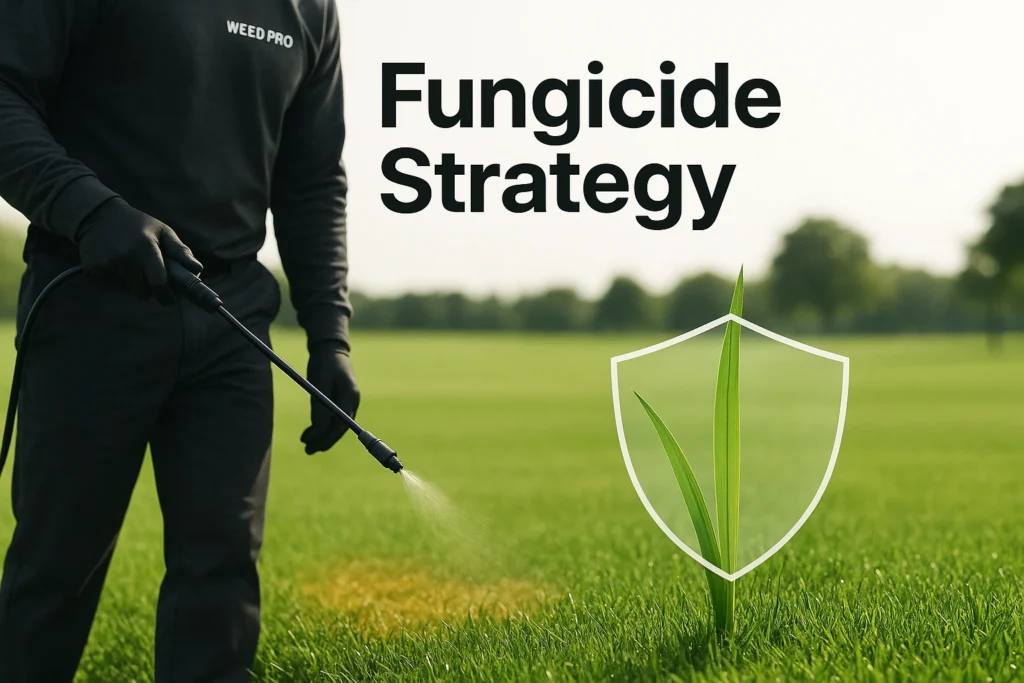
If you have arrived here searching for farming tips in Old School RuneScape (OSRS), this guide isn’t for you. However, if you are a homeowner or property manager staring at a lawn or garden that seems to be deteriorating before your eyes, you are in the right place.
Fungal pathogens are responsible for approximately 85% of all plant diseases, according to Michigan State University Extension. That makes fungus the single most likely culprit when your landscape starts failing. But identifying the problem is only step one. The real challenge—and where most homeowners go wrong—is selecting the right treatment class and applying it without destroying your soil’s microbial ecosystem.
At Weed Pro, we believe in Integrated Chemical Management. This means we don’t just spray and pray. We evaluate the disease stage, select the precise mode of action, and manage resistance to ensure your lawn remains resilient for years to come.
The Diagnosis Vault: Is It Actually Fungus?
Before you reach for a bottle, you need to validate your target. Misdiagnosis is the leading cause of treatment failure. A fungal infection often looks deceptively similar to bacterial blight, sun scorch, or even insect damage.
For example, Brown Patch (Rhizoctonia solani) often creates circular rings with a “smoke ring” border, whereas drought stress creates irregular, crispy patches. Powdery Mildew looks like dusted flour, but Downy Mildew (a water mold) creates yellow spots on top of leaves with grey fuzz underneath.
If you treat a bacterial infection with a fungicide, you are wasting money and introducing unnecessary chemicals into your environment. We recommend starting with a clear lawn diagnosis to distinguish between fungal spots and bacterial issues.
The Core Comparison: Systemic vs. Contact Fungicides
Once you have confirmed a fungal pathogen, you face a binary choice: Systemic or Contact?
Most “big box” store advice suggests buying a generic “disease control” spray. This is insufficient for high-value landscapes. You must choose your weapon based on whether you are trying to shield the plant or cure it.
Contact Fungicides (The Shield)
Contact fungicides (like Chlorothalonil or Maneb) coat the exterior of the leaf. They are a suit of armor.
- Best for: Prevention. They stop spores from germinating on the surface.
- Pros: Very low risk of resistance; excellent for “locking down” a healthy lawn before humid weather hits.
- Cons: They do not protect new growth that appears after spraying, and rain can wash them off. They cannot cure an infection that is already inside the leaf.
Systemic Fungicides (The Medicine)
Systemic fungicides (like Propiconazole or Azoxystrobin) are absorbed into the plant tissue. They move through the vascular system.
- Best for: Curative action and long-term protection.
- Pros: They are rainfast once dry, protect new growth, and can stop a fungus that has already penetrated the leaf surface.
- Cons: High risk of resistance if overused. They can affect the internal microbiome of the plant.
Deployment Strategy: The Curative Window
Timing is not just a suggestion; it is the primary factor in efficacy.
Research indicates that systemic fungicides have a post-infection activity window of 24 to 72 hours. This means if a spore penetrates your grass blade on Monday, and you spray a systemic curative on Thursday, you can likely stop the disease. If you wait until Saturday, the fungus is established, and the damage is irreversible.
If you are seeing widespread damage, such as large dead circles, you are past the preventative stage. You need a strategy for brown patch lawn repair that involves arresting the spread immediately with a curative systemic, followed by a recovery plan.
Conversely, if the weather forecast predicts three days of high humidity and 70°F nights (prime conditions for fungus), a contact fungicide applied before the rain offers the best protection.
Eco-Conscious Management: Protecting the Microbiome
At Weed Pro, we recognize that your soil is alive. Heavy use of synthetic fungicides can have unintended consequences. Recent studies (PubMed PMC9994715) show that synthetics like tebuconazole can significantly reduce the richness of phyllosphere fungi and beneficial endophytes that help your grass fight off heat stress.
To balance efficacy with ecology, we utilize a “Professional Middle Ground”:
1. Sulfur and Bio-Fungicides
For mild infections or prevention, sulfur-based treatments are highly effective and have almost zero impact on beneficial bacterial diversity. They are excellent for keeping annual lawn maintenance eco-friendly.
2. Targeted Gnat Control (BTI)
Often, homeowners confuse fungus gnats for a disease issue. Gnats thrive in moist, fungal-rich soil. Rather than soaking the soil in broad-spectrum toxins, we recommend BTI (Bacillus thuringiensis israelensis). This biological agent targets only the gnat larvae without harming earthworms, pets, or beneficial microbes.
3. Integrated Pest Management (IPM)
Chemicals should be the last step, not the first. Improving airflow (aeration) and reducing shade often solve atlanta lawn problems more permanently than any spray.
The Advanced Strategy: FRAC Codes and Rotation
If you take one thing away from this guide, let it be this: Do not use the same fungicide twice in a row.
Fungi adapt incredibly fast. If you repeatedly use a product with the same “Mode of Action,” the surviving fungus will breed a super-colony that is immune to that treatment. This is where FRAC (Fungicide Resistance Action Committee) codes come in.
Every professional fungicide has a FRAC code on the label (e.g., Group 3, Group 11). To prevent resistance, you must rotate these codes.
Sample Rotation for Heavy Disease Pressure:
- Application 1: Propiconazole (FRAC Group 3) – Systemic Curative
- Application 2: Azoxystrobin (FRAC Group 11) – Different Systemic Mechanism
- Application 3: Chlorothalonil (FRAC Group M5) – Contact Multi-site (Reset Button)
By rotating, you attack the fungus from different angles, ensuring it never develops immunity. This is the standard of care we bring to every property.
Taking the Next Step
Managing fungal pathogens requires a balance of chemistry, biology, and timing. While DIY solutions can work for minor issues, systemic disease often requires professional-grade products and strict adherence to resistance management protocols.
If you are seeing signs of disease and want to ensure your lawn is treated with an eco-conscious, rotation-based strategy, we are here to help. Contact Weed Pro today for a comprehensive assessment of your lawn’s health.
Frequently Asked Questions
Is it safe for my pets to go on the lawn after treatment?
For most liquid fungicides, the rule is “safe once dry.” Once the application has dried on the leaf surface (usually 1-3 hours depending on humidity), the risk of transfer is minimal. However, always read the specific label instructions, as Granular products often need to be watered in first.
Can I mix a fungicide with a weed killer?
Technically, yes, this is called “tank mixing.” However, we advise caution. Some combinations can precipitate (turn into solid goo) or cause “phytotoxicity” (chemical burn) on your grass. It is safer to separate your weed and disease applications by a few days to reduce stress on the lawn.
Why do I keep getting fungus in the same spot every year?
Fungi produce “overwintering structures” (sclerotia) that hide in your soil or thatch layer. If you have a recurring spot, it means the pathogen is dormant in that area. You need a preventative soil-conditioning program in the spring, not just a curative spray in the summer.