Most property managers and HOA boards view landscaping as a line item on the expense sheet—a necessary cost to keep the grass green and the weeds down. But if you are managing a commercial portfolio, a retail park, or a residential community, you know the reality is far more complex.
Your landscape isn’t just “maintenance.” It is the first 30 seconds of a prospective tenant’s experience. It is a physical signal of your management competency.
We need to shift the conversation from “cutting grass” to Commercial Asset Value Protection. While BOMA standards meticulously measure interior rentable square footage, they often have a “blind spot” regarding the site’s exterior impact on rental premiums. This guide is designed to help you evaluate your turf management strategy not as a chore, but as a financial lever that drives tenant satisfaction and property value.
The Financial Case for Aesthetics
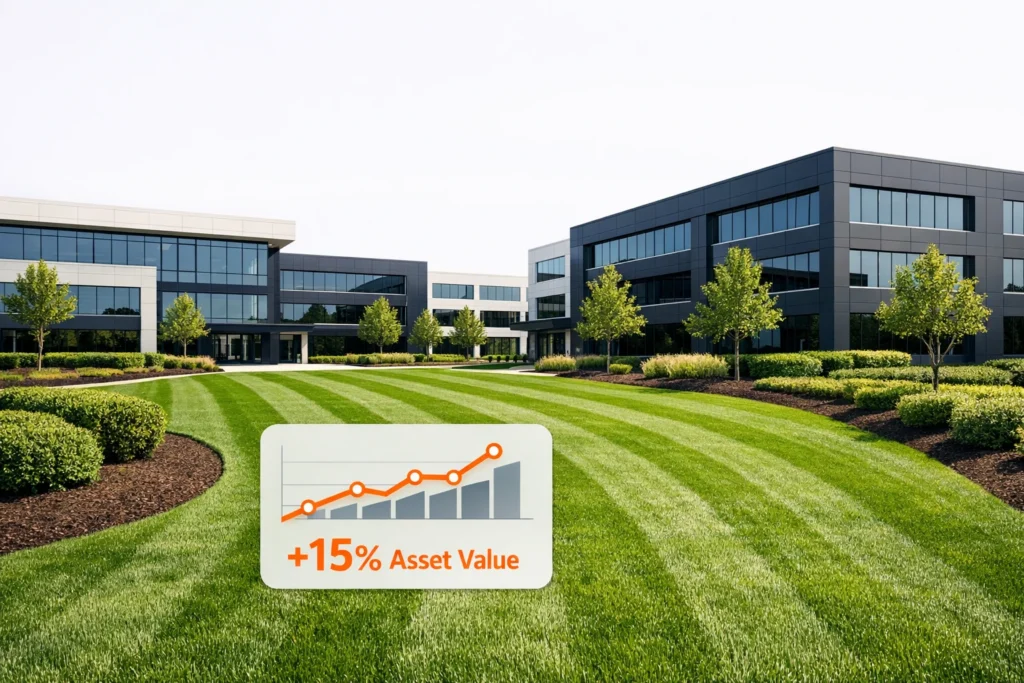
Let’s look at the data. Research indicates that professionally maintained landscapes can boost commercial property values by up to 15%. This is the “Curb Appeal Premium.” Conversely, neglected exteriors create an immediate “discount mentality” in prospective tenants before they even step into the lobby.
When you calculate the ROI of your landscape maintenance contract, you must factor in the “Risk of Aesthetics.” If your current vendor allows the turf to degrade, you aren’t just paying for mowing; you are paying for the future capital expense of re-sodding and the soft cost of tenant complaints.
A strategic partner understands that your goal isn’t just short grass; it is protecting the property’s cap rate. By investing in a program that prioritizes plant health, you effectively reduce the “Standard Deviation of Aesthetics”—ensuring your property looks consistent whether it is April or August.
The Aesthetic Audit: A 10-Point Scorecard for PMs
How do you objectively measure if your current vendor is failing? “It looks bad” is subjective. To make data-driven decisions, you need an audit framework.
We recommend evaluating your property against a specific set of criteria. If you are walking a site and noticing “aesthetic drift”—where the quality slowly degrades over months—it is time to audit.
The Property Manager’s Aesthetic Checklist:
- Turf Density: Can you see the soil through the grass blades?
- Color Consistency: Is the green uniform, or are there patches of chlorosis (yellowing)?
- Weed Threshold: Are broadleaf weeds visible in high-visibility entrance zones?
- Edge Definition: Are the bed lines crisp and distinct, or is turf encroaching on mulch?
- Irrigation Coverage: Are there “donuts” of dry grass around sprinkler heads indicating poor pressure or adjustment needs?
- Hardscape Intrusion: Is grass growing in cracks of the sidewalks or curbs?
- Compaction Levels: Is the soil in high-traffic areas hard as rock?
- Thatch Buildup: Is there a spongy layer inhibiting water absorption?
- Pest Damage: Are there signs of root damage from grubs?
- Portering Detail: Is trash and debris cleared prior to mowing?
Often, the difference between a failing landscape and a thriving one comes down to water management. If you notice wet spots or dry patches, you may need sprinkler system repair in Atlanta or your local region immediately. Ignoring these signs leads to rapid asset depreciation.
Comparison: The “Mow & Blow” vs. The Strategic Partner
When evaluating proposals, it is easy to gravitate toward the lowest bottom-line number. However, low-cost “Mow and Blow” operations often achieve their price point by cutting corners that you pay for later.
A “Mow and Blow” crew focuses on task completion: Did we cut the grass? Yes. Invoice sent.
A Strategic Partner focuses on asset management: Is the turf healthy? Is the soil pH balanced? Are we mitigating liability risks?
The Hidden Costs of the Low Bidder
- Reactive vs. Proactive: Cheap vendors wait for you to complain about weeds. A partner applies pre-emergents to prevent them. If you are constantly calling about dandelions, you need to evaluate weed control services near me that prioritize prevention over reaction.
- The Communication Gap: Does your vendor provide a monthly site report? Or do you only hear from them when they want to renew the contract?
- Liability Exposure: Unqualified crews often miss safety hazards like deep ruts or irrigation leaks that cause slip-and-fall risks.
Technical Deep Dive: High-Traffic Recovery & Sustainable ROI
Commercial properties face abuse that residential lawns do not. Delivery trucks park on the verge; tenants create “desire lines” by cutting corners; dog walkers use common areas. This compaction destroys the soil structure, choking the grass roots.
Recovering these areas requires more than just seed. It requires a technical understanding of soil science.
Addressing Compaction and Root Health
To maintain density in high-traffic zones, mechanical aeration is non-negotiable. By pulling plugs of soil, we allow oxygen and water to reach the root zone. For commercial properties, we often recommend pairing lawn aeration in Atlanta (or your specific locale) with high-quality overseeding to introduce more resilient turf varieties.
The Water-Wasters: Irrigation Efficiency
Sustainable ROI is about reducing waste. Older commercial irrigation systems often waste thousands of gallons due to poor calibration. Modernizing your system isn’t just “green” in the environmental sense; it saves significant operating capital. Whether it’s a simple head adjustment or a full irrigation repair in Atlanta, fixing leaks and optimizing zones can reduce water usage by massive margins—data suggests up to 70% in some retrofit cases.
Sub-Surface Threats
Sometimes the damage isn’t from foot traffic, but from below. Grubs can devastate a large commercial lawn in a matter of weeks, turning a green asset into a brown liability. This is where proactive grub control in Atlanta and similar regions becomes an insurance policy for your landscape.
Managing the Seasonal Lifecycle
A great landscape isn’t built in a day; it is planned over a year.
- Spring: Focus on pre-emergent weed control and waking up the turf.
- Summer: Manage heat stress, irrigation monitoring, and pest control.
- Fall: This is your investment season. Lawn overseeding service combined with aeration sets the stage for the following year.
- Winter: Dormancy management and preparation for the spring flush.
Sometimes, despite best efforts, damage occurs. Snow plows scrape edges, or utility work tears up a section. In these cases, having a partner ready with lawn repair solutions ensures that your property doesn’t stay scarred for long.
The Next Step in Your Evaluation
If your current curb appeal isn’t reflecting the quality of your brand, it is time to re-evaluate your strategy. Don’t settle for a vendor who just sends an invoice. Look for a partner who provides a scorecard, understands the financial implications of curb appeal, and proactively manages your asset.
We invite you to review your current property against the audit points listed above. If you find gaps, let’s have a conversation about closing them and protecting your property’s value.
Frequently Asked Questions
Q: How does landscaping actually affect property value?
A: Beyond the 15% valuation premium, a well-maintained exterior signals to tenants that the building systems (HVAC, plumbing) are likely also well-maintained. It builds trust and justifies higher rental rates per square foot.
Q: Why is commercial turf management more expensive than residential?
A: Commercial management involves higher liability insurance, strict adherence to safety protocols (PPE), rigorous scheduling to avoid business disruption, and the scale of equipment required to maintain large acreages efficiently.
Q: Can we just reduce the number of mowings to save money?
A: Cutting frequency often leads to “haying” (clumps of grass left behind) and puts stress on the turf, leading to disease. It’s better to adjust the type of care rather than the frequency of the cut.