You’ve likely stood on your porch, looking at a spreading patch of discolored turf, and asked the inevitable question: “Is that fungus, or is my lawn just dry?”
For most homeowners, the next step is a trip to the hardware store to buy a bag of generic fungicide. But if you are reading this, you probably know that approach often fails. You apply the product, the spots remain, and the lawn continues to deteriorate.
This is where the difference between “lawn care” and “lawn pathology” becomes critical.
True diagnostic work isn’t about guessing based on the color of a blade of grass. It is a clinical process of elimination. Industry data suggests that up to 30% of diagnosed “fungal” issues are actually abiotic—caused by environmental stress, chemical burn, or soil compaction—meaning expensive fungicide treatments are often completely wasted.
At Weed Pro, we bridge the gap between visual guesswork and clinical certainty.
The Expertise Gap: Why Visual Identification Fails
The internet is flooded with “lawn disease identification charts” that rely on surface symptoms. You see white substance on the blades? The chart says Powdery Mildew. You see circular rings? It says Brown Patch.
While these guides are helpful starting points, they lack the depth required for treatment decisions. Visual symptoms are often lagging indicators—by the time you see the damage, the pathogen has been active for weeks.
More importantly, different pathogens can present nearly identical symptoms to the naked eye but require opposite treatments.
The Pythium vs. Rhizoctonia Dilemma
Consider two of the most destructive turf destroyers: Pythium Blight and Rhizoctonia (Brown Patch).
- Visual Check: Both create blighted, irregular patches of turf that look “greasy” or water-soaked in the morning dew.
- The Treatment Risk:Pythium is an Oomycete (a water mold), not a true fungus. Standard fungicides designed for Rhizoctonia often have zero effect on Pythium. If you treat for the wrong one, the disease spreads unchecked, potentially killing the lawn in 24-48 hours.
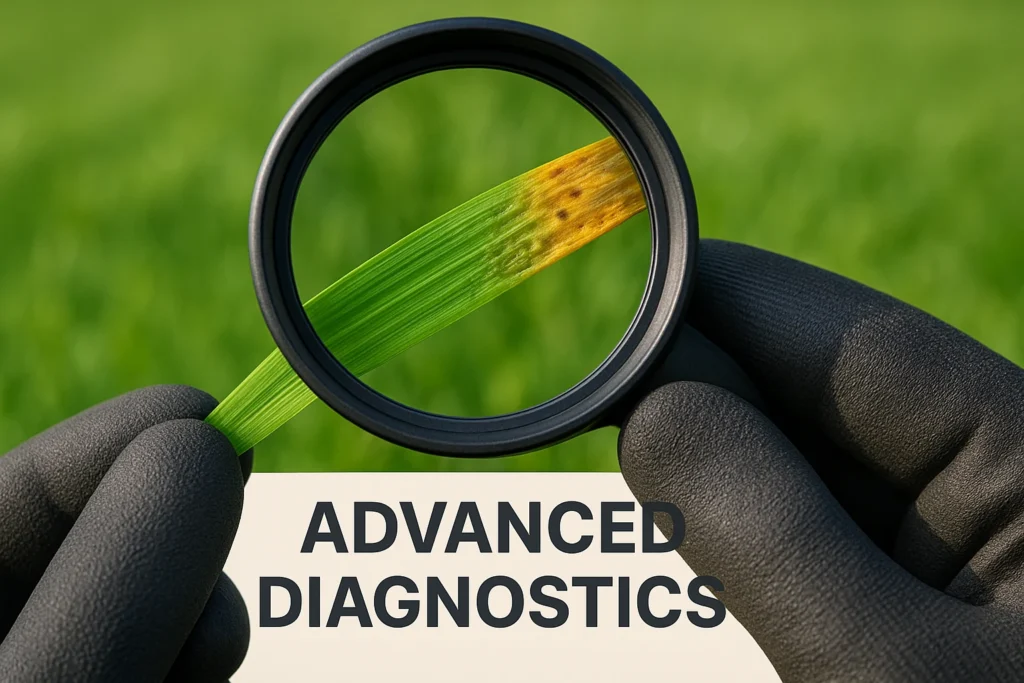
This is why we move beyond visual scans to what we call the “Clinical Lens.”
The Clinical Arsenal: Microscopy and Lab Analysis
When a diagnosis isn’t immediately clear from environmental context, we don’t guess. We investigate. Professional lawn diagnosis involves examining the physical structure of the pathogen itself.
Under the Microscope: Septate vs. Non-Septate Hyphae
The definitive way to distinguish between a fungal infection and a water mold is to look at the mycelium (the vegetative part of the fungus) under 40x magnification.
- Rhizoctonia (Brown Patch): Under the scope, we look for septate hyphae—strands that have distinct cross-walls (septa) branching at right angles. This confirms a true fungal infection amenable to standard fungicides.
- Pythium (Blight): We look for non-septate hyphae—continuous tubes without cross-walls. Seeing this immediately changes the protocol to specific Oomycete-targeting chemistry.
This level of detail is impossible to achieve with the naked eye, yet it is the only way to guarantee the treatment will work.
Interpreting “The Pull Test” and Soil Patterns
Not every diagnostic requires a microscope. Some of the most valuable data comes from physical interaction with the turf structure.
A common diagnostic challenge we face in Ohio and surrounding markets is distinguishing between drought stress, insect damage, and root diseases.
The “Grass Cracks” Mystery
Homeowners often report “cracks” or lines appearing in the lawn.
- Scenario A (Abiotic): If the soil is shrinking due to extreme desiccation (dryness), the ground physically cracks, tearing roots.
- Scenario B (Biotic):Rhizoctonia can cause “smoke rings” or patterns that mimic cracking.
To solve this, we perform a “tug test.” If the turf pulls up like a loose carpet, the roots have been severed. If there are white grubs present, it is an insect issue. If the roots are black and rotted but no insects are found, we are likely looking at Take-All Root Rot or similar pathogens.
However, if the turf is rooted firmly but the blades are withering, we are looking at specific leaf blights or atlanta lawn problems like heat stress, which require hydration strategies rather than chemistry.
When to Escalate: DNA Testing and Soil Assays
Visual and microscopic identification solves 90% of cases. But what about the chronic issues that return year after year, regardless of treatment?
This is where Polymerase Chain Reaction (PCR) testing and comprehensive soil assays come into play. Root-infecting pathogens like Summer Patch or Necrotic Ring Spot work underground, destroying the root system long before symptoms appear on the blades.
By the time you see brown patch grass symptoms, the damage is done.
For these complex cases, we may recommend sending soil and tissue samples to a pathology lab. These assays can identify:
- Pathogen Load: Not just if a disease is present, but the concentration of it.
- Nutrient Antagonism: Sometimes, excessive nitrogen can fuel disease. Proper soil testing ensures we aren’t feeding the fungus while trying to kill it.
The Decision Threshold
You do not need a lab test for every clover patch. Professional management is about knowing when to treat and when to test.
The Professional Protocol: The 6×6 Sample
If you decide that your lawn issues require professional lab analysis, the integrity of the sample is paramount. You cannot simply pull a handful of grass and mail it.
Universities like NC State and Penn State utilize strict sampling protocols that we mirror:
- The Margin: We sample from the margin of the disease—where the dead grass meets the living. This is where the pathogen is most active.
- The Plug: We extract a 6×6 inch square, including 3 inches of root zone and soil.
- Preservation: Samples are wrapped in foil (never plastic, which induces rot) and shipped overnight to prevent secondary mold growth that obscures the primary pathogen.
The Next Step for Your Lawn
A healthy lawn is an ecosystem, and sometimes ecosystems get sick. The difference between a minor setback and a total renovation often comes down to the accuracy of the diagnosis.
If you are tired of wondering what is eating your turf, let’s get a definitive answer. Reach out to the team at Weed Pro. We don’t just look at your lawn; we examine it.
Frequently Asked Questions
Why can’t I just use a “curative” fungicide for everything?
Broad-spectrum fungicides exist, but they have limitations. Overusing them can lead to pathogen resistance, meaning the disease becomes immune to the cure. Furthermore, using a fungicide on an abiotic issue (like drought stress) adds chemical stress to a plant that is already struggling to survive.
How do I know if I need a lab test?
If you have treated the lawn for a specific issue twice with no results, or if the lawn is declining rapidly (within 24 hours), it is time to stop guessing and start testing.
Does Weed Pro handle the testing?
Yes. As part of our comprehensive weed control services, we assess lawn health holistically. If a technician suspects a complex pathogen, we can facilitate the analysis and, more importantly, interpret the results to build a recovery plan.